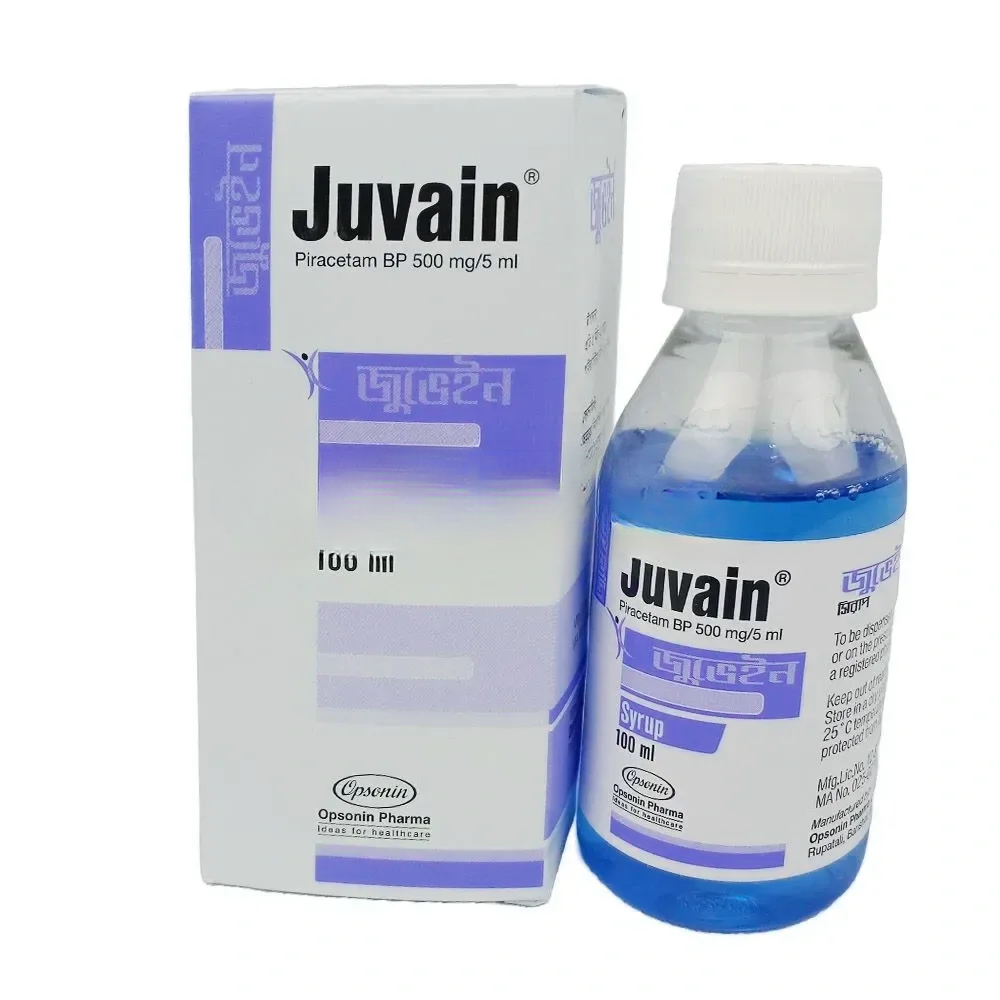
Cerebral vascular accidents and cerebral insufficiencies: Ischaemic or even hemorrhagic acute accidents, chronic manifestations of the above accidents or of cerebral atherosclerosis.
Mental retardation in children: Ease of resuming individual contact, sociability
🔹
Pharmacology
ফার্মাকোলজি
Piracetam is a 'nootrope', that is to say, it is a psychotropic agent which acts directly on the brain to improve the efficacy of the telencephalon in both normal subjects and those suffering from some functional deficit. This area of the brain is involved in cognition and also has a role to play in learning and memory, in alertness and in consciousness. Piracetam does not produce either sedation or stimulation. Piracetam can act on the central nervous system in a variety of ways. It will modify neurotransmission within the brain, and can help to improve the metabolic environment essential for good neuronal function. It is also a haemorrheological agent and can improve microcirculation without producing vasodialation. When given as acute or long term treatment for patients' suffering from a functional CNS deficit, it will heighten alertness and increase cognitive function. This changes can seen as a significant increase in the a-and b-activity, with a reduction in d-activity on an EEG trace. Piracetam will protect and restore cognitive functional capacity for cerebral trauma, e.g. hypoxia or intoxication, and after electroshock therapy. Piracetam may be given alone or together with other drugs when treating myoclonia due to anoxia. It will reduce the duration of vestibular nystagamus. Piracetam will also improve regional oxygen and glucose uptake in the brain in patients suffering from dementia subsequent to multiple infarcts, or in those with cerebral ischaemia. Piracetam will inhibit the increased aggregation of activated platelets and, in conditions where there is abnormal rigidity of the RBC, it can restore deformability and the ability to pass through the microvasculature.
Piracetam is a 'nootrope', that is to say, it is a psychotropic agent which acts directly on the brain to improve the efficacy of the telencephalon in both normal subjects and those suffering from some functional deficit. This area of the brain is involved in cognition and also has a role to play in learning and memory, in alertness and in consciousness. Piracetam does not produce either sedation or stimulation. Piracetam can act on the central nervous system in a variety of ways. It will modify neurotransmission within the brain, and can help to improve the metabolic environment essential for good neuronal function. It is also a haemorrheological agent and can improve microcirculation without producing vasodialation. When given as acute or long term treatment for patients' suffering from a functional CNS deficit, it will heighten alertness and increase cognitive function. This changes can seen as a significant increase in the a-and b-activity, with a reduction in d-activity on an EEG trace. Piracetam will protect and restore cognitive functional capacity for cerebral trauma, e.g. hypoxia or intoxication, and after electroshock therapy. Piracetam may be given alone or together with other drugs when treating myoclonia due to anoxia. It will reduce the duration of vestibular nystagamus. Piracetam will also improve regional oxygen and glucose uptake in the brain in patients suffering from dementia subsequent to multiple infarcts, or in those with cerebral ischaemia. Piracetam will inhibit the increased aggregation of activated platelets and, in conditions where there is abnormal rigidity of the RBC, it can restore deformability and the ability to pass through the microvasculature.